Posts

A Whirlwind Season

Image
At Trackers Skishoes, we try to get out on the snow as much as possible to demo skishoes and show people the beauty of skishoeing. Sometimes, it may be part of a large, formal event, while other times, we strike out on our own in unexplored areas and preach the skishoe gospel to anyone who asks about them. In doing this, we come across some interesting and fun locations, sometimes unexpectedly. Here are a few from last season (2017-18). Tannersville, NY In the heart of New York’s Catskill Mountains, Tannersville lies in the shadow of Hunter Mountain, the well-known downhill ski resort. It comes after a drive from the east on Route 23A through spectacular, gorgeous terrain. A mere quarter mile west of town you find Mountain Trails Cross Country Ski Center with its dizzying array of trails. They encourage snowshoeing here, and you can go on the trails (staying out of the ski tracks, of course) or venture off trail through the woods. When the Panther Pass and Eagle Flight...
Product Improvements for the Coming Season

Image
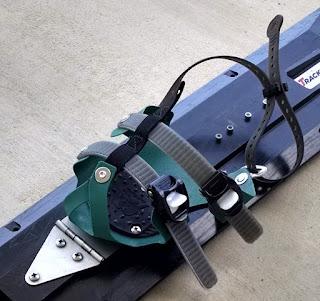
We're entering our third season of selling skishoes. Along the way, our customers have suggested improvements they'd like to see in our products. In response, we've added a handful of them for this season, and a couple are in the pipeline. For starters, a few people that purchased skishoes with snowshoe bindings, our most popular model, requested a binding that's easier and quicker to get in and out of. We came up with the ratchet binding made by GV Snowshoes. It has a toe box so you can locate your foot quickly and precisely, and the ratchet straps crank down quickly and tightly. Along with this, we added heel stabilization screws (4 on each side) to hold your heels in place on the ski in the presence of snow and ice. Actually, we made these changes last season. We heard from several people that the bindings on our skishoes were mounted slightly too far forward. This was especially noticeable on downhills, as the front of the skishoe would sink in the snow. We m...

The Search for Powder

Image
Absolute powder corrupts. That's how they explain the spike in absenteeism after a big snowstorm in Colorado, as folks head for the slopes. For Joel Gratz, though, it becomes just another work-related field trip, to check first hand on the accuracy of his forecast. His website, OpenSnow is totally focused on making accurate, pin-point predictions of "powder days" at Colorado ski areas. And his reputation is becoming legendary, as he brings Powder to the People (OK, no more puns). Joel and his ten colleagues at OpenSnow  (not counting mascot Bruce the Snowman) bring intense scrutiny to weather data in order to quantify, as only weather- & data-nerds can, their forecasts. They report their conclusions with freshness, wit, honesty, sometimes exhilaration, sometimes humility, and have gained a popular following that numbers in the millions. Read below in a question-and-answer interview format how this enterprise has turned Joel...

How Do You Make a Skishoe?

Image
We advertise that our skishoes are handcrafted in central Pennsylvania. But what does that mean? How do we do it? It may sound simple in theory, but it gets complicated. I must confess that not every part or component of a skishoe is made here, or even in this country, but we do our best to keep things local, or at least made in the United States. The main component of our skishoe is the ski, actually a hunk of high-density polyethylene (HDPE) plastic, the same #2 material you see in common plastic jugs. For small quantities, we have the ski machined from 4’x8’ sheets of material by MPC Industries, a machine shop in Lancaster, PA. Machining doesn’t lend itself to offering different colors. The material comes in black and red, and black is cheaper, so we go with that to keep our costs down. The skis are machined straight, so once we get them in house, we form the tip on the front end. We do this by heating it with a torch and then bending and holding it in a fixture...

New Winter Sport That Really Isn’t So New

Image
Over the past several years, a seemingly new winter sport has emerged that combines skiing and snowshoeing. It has gained traction (literally) as snowshoes have become more popular and high tech over the last 20 years. It has no official name, so many of us just call it skishoeing. Some of us label the instruments sliding snowshoes or hybrids. But skishoeing is actually not that new, as a search through patents reveals that inventors have been coming up with myriad designs for many decades. Independent souls have tried to commercialize them along with a few major players. No trade group for skishoeing exists, maybe because no standard design exists like with skis or snowshoes. Indeed, all skishoes currently out there are different. Some are more like skis, while others are more like snowshoes. They all basically grip while climbing, then glide on flats and coming downhill with varying amounts of turning ability. With a wide platform, they have more flotation for handling p...

Descending on skishoes

One of the most common questions we get about Trackers Skishoes is how do you take them down hills. Can you turn them? Generally, no; most descents are done in straight-ahead fashion without making turns - in fact, we've dubbed it straight-line skiing. In almost all conditions, the width of the skishoes combined with the gliding crampons will slow you on descents and give you more stability as compared with cross-country skiing. This is especially true with crusty snow and powder. Generally, the harder the snow, the more the crampons will slow you, as they actually saw through ice and crust. Powder is inherently slow, so you'll float through that. Many of us dream of skiing in knee-deep powder at downhill ski resorts and live for powder days. Straight-line skiing through powder on skishoes gives you a similar thrill, so now you can dream of that. Five different scenarios exist, depending on the steepness of the terrain and snow conditions. For moderate conditions, which usual...